
Average Allowance by Age: Research-Backed 2026 Guide
“How much are other parents paying?” — the question nobody asks out loud at pickup line. We analyzed data from over 10,000 families to answer it honestly, plus give you the full system behind the numbers.
A Common Parent Story
One parent in our community shared: “I gave my 9-year-old $20 and said manage it for the month. Two days later it was gone on slime kits. I was furious — until I realized: of course she couldn't manage it. I'd never actually taught her how.”
The right amount matters, but the system behind it matters more. This guide gives you both.
Why Allowance Is More Than Just Cash
Allowance is no longer just about buying candy — it is your child's first financial education. Studies show children who practice managing their own money before age 12 are significantly more likely to save consistently, avoid consumer debt, and invest early as adults. The habits formed during these years compound just like interest.
Delayed Gratification
Learning to save for a big purchase is the single strongest predictor of future financial success — stronger than income or education level.
Low-Stakes Mistakes
Better to lose $10 on a bad toy at 8 than $10,000 on a bad investment at 28. Allowance is a safe sandbox for real financial decision-making.
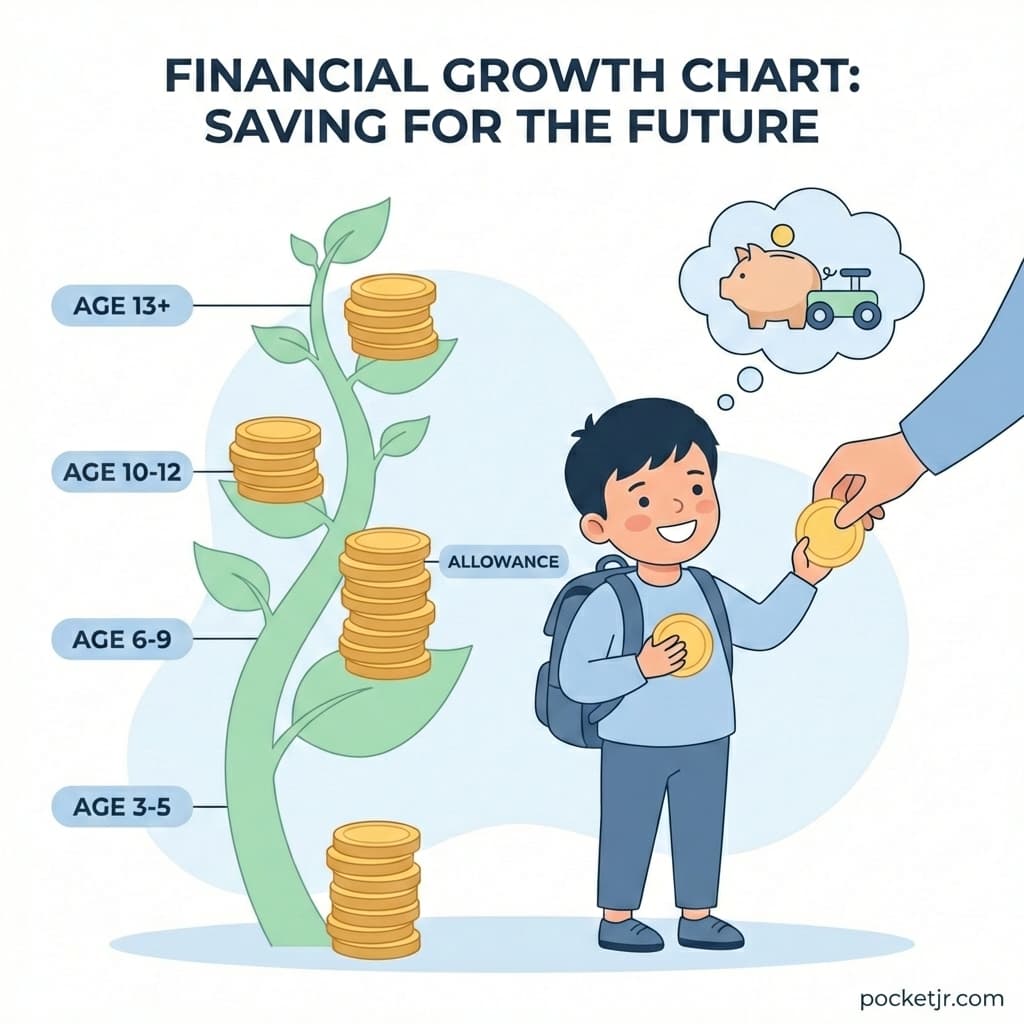
The “Dollar per Year” Rule — The Best Starting Point
The most widely used formula is simple: $1 per week for every year of age. A 6-year-old gets $6/week, a 10-year-old gets $10/week, a 15-year-old gets $15/week. This scales naturally with growing wants and responsibilities — no constant renegotiation needed.
It is a starting point, not a law. Your cost of living, what the allowance is expected to cover, and your child's individual financial maturity all factor in. Use the rule to anchor your thinking, then adjust with the full age breakdown below.
Complete Allowance Chart by Age — 2026
Based on the $1/week rule adjusted for what children can realistically self-fund at each developmental stage. This is your negotiating baseline.
| Age | Weekly | Monthly | Annual |
|---|---|---|---|
| 5 yrs | $5 | $20 | $260 |
| 6 yrs | $6 | $24 | $312 |
| 7 yrs | $7 | $28 | $364 |
| 8 yrs | $8 | $32 | $416 |
| 9 yrs | $9 | $36 | $468 |
| 10 yrs | $10 | $40 | $520 |
| 11 yrs | $11 | $44 | $572 |
| 12 yrs | $12 | $48 | $624 |
| 13 yrs | $13 | $52 | $676 |
| 14 yrs | $14 | $56 | $728 |
| 15 yrs | $15 | $60 | $780 |
| 16 yrs | $16 | $64 | $832 |
| 17 yrs | $17 | $68 | $884 |
* Adjust ±30% for your local cost of living and what specific expenses you expect the allowance to cover.
How Families Actually Structure Allowance in 2026
Raw dollar amounts tell only half the story. The bigger differentiator is the philosophy behind the allowance — and it shapes kids' money habits more than the dollar amount itself.
Pay $0.50–$1.00 per year of age. Focus on savings and small treats. Most common starting point for families new to structured allowance.
Pay $1.50–$2.00 per year of age. Kids self-fund apps, outings, and hobbies. Creates stronger habits but requires more parental coaching upfront.
No set allowance. Everything is earned through a task list. Strong work ethic, but inconsistent income undermines budgeting practice.
Want a personalized recommendation?
Use our interactive calculator to get a precise amount based on your child's exact age, your location, and what you want the allowance to cover.
How to Raise the Bar Each Year Without Drama
Most parents either forget to raise allowance for years and then add a guilt-driven lump sum, or raise it automatically every birthday with zero conversation. Both miss a golden teaching opportunity.
Instead, schedule an Annual Allowance Review around their birthday. Sit down together and ask three questions:
- What did you spend money on this year that you felt proud of? (reinforces good decisions)
- What do you wish you had saved more for? (builds forward-thinking)
- What new things are you ready to pay for yourself next year? (makes them co-own the raise)
A raise tied to expanding responsibility — not just a birthday — teaches that income is earned. Kids who help negotiate their own allowance are also far more motivated to actually manage it well.
Does Your Location Change How Much to Pay?
Yes — significantly. The same $10 buys very different experiences for a child in rural Iowa versus Manhattan. A quick regional reference:
The Sibling Fairness Problem: “That's Not Fair!”
If you have children of different ages, brace yourself for complaints. A 7-year-old watching their 13-year-old sibling get nearly double the allowance will feel it keenly. Here is how to handle it well:
- Explain the logic, not just the rule: “Your sister gets more because she pays for her own movie tickets and snacks with friends. As you get older, you'll have the same responsibility — and the same amount.” This reframes the difference as upcoming opportunity.
- Show them the progression table: Pull up the chart above. Point to their age, then their sibling's. Let them see the path they are already on.
- Offer bonus chores as a bridge: Let younger children earn extra through optional tasks to close the perceived gap while reinforcing that higher income requires more effort.
- Never equalize downward: Reducing the older child's allowance to appease the younger one teaches entirely the wrong lesson — that fairness means equal outcomes regardless of responsibility.
The Great Chores Debate: Should Allowance Be Tied to Work?
Should allowance be earned through work, or is it a financial education tool entirely separate from household contribution? Both camps have real evidence behind them. Here is the honest breakdown:
Model A“The Salary”
Allowance tied directly to chores. No work = no pay. Mirrors the real-world economy.
- ✅ Teaches work ethic from an early age.
- ✅ Simulates real-world economics clearly.
- ✅ High earners feel genuine ownership over money.
- ❌ Kids may refuse chores if they don't need money that week.
- ❌ Family contribution becomes transactional.
Model B“The Citizen”
Fixed allowance for learning; chores are a family expectation, not compensated.
- ✅ Family contribution stays intrinsically motivated.
- ✅ Consistent income allows real budgeting practice.
- ✅ Simpler for parents to enforce — separate conversations.
- ❌ Can feel like “free money” to some children.
Our Recommendation — The Hybrid Model: Provide a small, fixed base allowance for consistent budgeting practice. Then post a weekly “Bonus Gig Board” — above-and-beyond tasks (washing the car, deep-cleaning a bathroom, helping with a younger sibling) that pay a defined premium rate. This gives kids a reliable income floor plus the ability to earn significantly more through initiative. It mirrors how the adult economy actually works far better than either extreme alone.
6 Allowance Mistakes Parents Make (and How to Avoid Them)
Paying irregularly or in lump sums
If you forget for three weeks and hand over $30, the budgeting lesson evaporates. Consistency is the entire point. Use an automated tool or a calendar reminder to pay on time, every week — the same day, without fail.
Using allowance as a punishment tool
Taking away allowance for bad behavior conflates money with morality. It undermines the financial education purpose and sends an unintended message: money is a reward for good behavior, not a neutral resource to be managed.
Bailing them out when they overspend
The sting of running out of money is the lesson. When you rescue them with extra cash, you remove precisely the consequence that makes the learning stick. Empathize. Hold the line.
Never clarifying what the allowance must cover
If you pay $10/week but still buy all their snacks, movie tickets, and in-app purchases, the $10 has zero teaching value. Be explicit upfront: your allowance is for anything you want beyond what we already provide as a family.
Forgetting to increase it as they get older
A 12-year-old receiving $5/week (set when they were 7) has had their real purchasing power cut in half by inflation and growing social expenses. Annual reviews matter. Set a recurring birthday reminder right now.
Going fully cash-only in a cashless world
Your child will navigate a nearly entirely digital financial world. If their only experience with money is physical coins and bills, you are preparing them for 1985, not 2035. Blend digital practice with physical cash from the beginning.
6 Expert Tips for Allowance Success
“Automation is everything.”
If you pay manually, you will eventually forget — and inconsistency destroys the lesson. Set up a recurring transfer so allowance arrives on the same day every week without fail. Punctuality teaches children that money is a reliable resource they can plan around. Payday on random days would cause chaos for any adult; your child's financial education deserves the same predictability.
“Hands off the spending.”
It is genuinely painful to watch a child spend two weeks of allowance on a toy forgotten in 48 hours. Let them. The remorse at age 9 — “I wish I hadn't bought that” — is exactly the neural pathway that prevents $50,000 in credit card debt at 29. Resist the urge to veto unless something is unsafe.
“Introduce digital money early.”
The world is cashless. Understanding that numbers on a screen represent real work and real value is one of the most important 21st-century skills you can teach. Use a digital tool alongside physical cash — let them watch their balance move up and down, and track progress toward a goal visually. This closes the loop between action and consequence in a way a piggy bank simply cannot.
“Match their savings, not their spending.”
One of the most powerful incentives you can offer: for every dollar your child saves, match 25–50 cents. This simulates a 401(k) employer match and makes saving feel immediately rewarding. You are not rewarding all money behavior — only the forward-looking kind. This single change can dramatically shift how much of their allowance ends up saved versus impulsively spent.
“Hold an annual money review together.”
Once a year around their birthday, sit down for a short financial review. Look back at how they spent their allowance. Celebrate the wins (“You saved four months for that game — that took real discipline!”). Explore regrets without judgment. Set a bigger savings goal for the coming year. This ritual builds financial reflection — a habit that separates people who get ahead financially from those who perpetually wonder where their money went.
“Make running out of money a teachable moment.”
When your child comes to you three days before allowance day with nothing left and a desperate ask, do not hand them money. Give them a conversation instead: “Let's figure out what happened this week. What's the one purchase you wish you hadn't made?” These five-minute conversations, repeated over years, build the habit of post-spending reflection that most adults never develop. The discomfort is the curriculum.
Frequently Asked Questions
What is the average allowance for a 10-year-old?
The average allowance for a 10-year-old in the US is $10 per week (about $40/month), based on the '$1 per week per year of age' rule. Surveys show a realistic range of $5–$20 per week depending on income, cost of living, and whether allowance is tied to chores.
At what age should I start giving my child an allowance?
Most child development experts recommend starting between ages 5 and 7, when children begin to understand money can be exchanged for goods. Starting too early (under 4) means the concept may not stick. Starting too late (over 10) means years of missed financial practice.
Should allowance be tied to chores?
A hybrid model works best: provide a small base allowance unconditionally for budgeting practice, plus offer optional bonus chores for extra earning. This separates family responsibility from financial compensation while still teaching the value of hard work.
How often should I pay allowance — weekly or monthly?
For children under 10, weekly is best — their sense of time is shorter and they need frequent feedback loops. For tweens (10–12), bi-weekly works well. For teens (13+), monthly mirrors adult paycheck budgeting and teaches how to stretch money over a longer horizon.
How should I handle it when my child runs out of allowance?
Do not bail them out. Running out of money is the most valuable lesson allowance teaches. Empathize and problem-solve: 'What would you do differently next week?' If genuine need exists, offer a one-time loan from next week's allowance with a clear repayment plan.
Should I increase my child's allowance each year?
Yes, but tie increases to responsibility, not just birthdays. An annual allowance review around their birthday is powerful: 'You're turning 12. What new things are you ready to pay for yourself?' This frames the raise as earned responsibility rather than an automatic entitlement.
Ready to put this into practice?
Automate your child's allowance, track their spending goals, and build real money skills — from one parent-controlled dashboard.
Create Free AccountSpecific Age-by-Age Deep Dives
Want chore suggestions, developmental milestones, and a precise allowance range for a specific age? Explore our detailed guides: